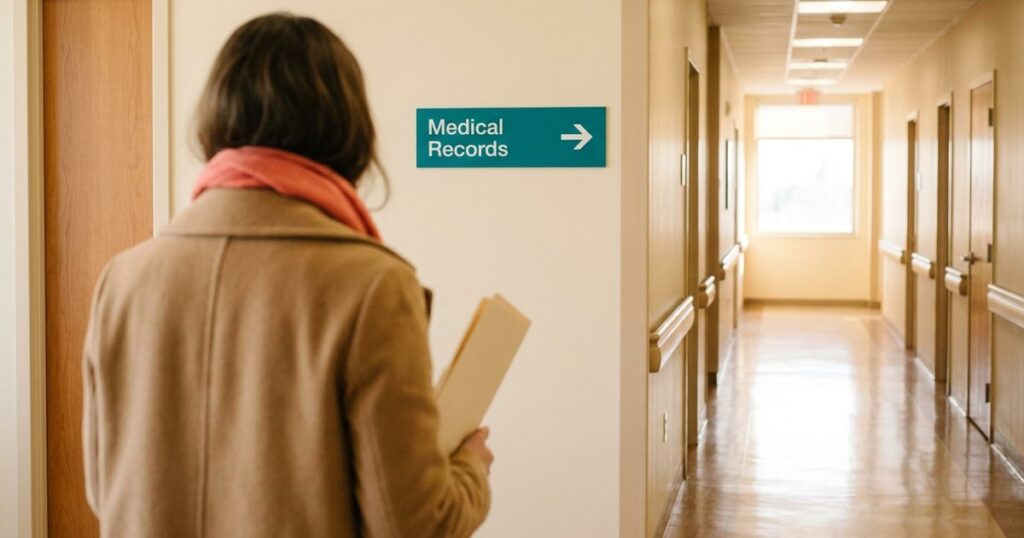
If you’ve searched for “medical records closed hospital” and come up empty, here’s why: Ohio doesn’t spell out who has to hold the charts once the doors lock. The charts may well still exist. Finding the person or company that holds them is the real job. Our guide on how to get your medical records in Ohio covers the request letter, the fees and the deadlines. This guide covers the step before that: working out who to send the letter to.
What happens to medical records when a hospital closes
Start with what the law does say. Ohio’s licensing rule for health care facilities requires a hospital to keep records for at least six years from the date of discharge, and to protect them from theft, loss and destruction ( Ohio Administrative Code 3701-83-11 ). We read the whole rule. It says nothing about what happens to the charts when the hospital shuts down, who must take them, or who has to tell patients where they went.
So in practice, it comes down to whoever signed the paperwork. A buyer takes the files as part of a sale. A parent company moves them. A storage vendor boxes them up under a contract. Every one of those can end up as the records custodian, which just means the person or company legally holding the charts. Once you know who that is, your request goes to them. Until then, you’re guessing.
For a deeper look at the six-year floor itself, see our explainer on how long hospitals keep medical records.
Medical records closed hospital: where they usually end up
A successor owner
If another system bought the hospital or its patient business, the charts often went with the sale. This is the easiest case. Call the buyer’s records department and ask whether they took the old hospital’s files.
A parent or former parent company
Hospitals that belonged to a chain sometimes had their records handled at the corporate level. If the chain later went bankrupt, the trail can run through court filings. That’s exactly what happened with the Northside records, which we get to below.
A storage company
Many hospitals pay a vendor to hold old charts offsite. When the hospital closes, the vendor may keep the boxes as long as someone keeps paying. Vendors usually can’t hand a chart to just anyone, though. They typically release records only on the say-so of the hospital or its successor, so expect to be pointed back to someone else.
A state agency
This happens, but it isn’t automatic. When Richland Hospital closed in October 2000, the Ohio Attorney General’s Office ended up with its patient records. A 2011 notice gave former patients until March 1, 2011 to contact the office and until March 15 to pick up copies, and warned that unrequested records could be destroyed after that ( Ohio Attorney General’s notice ). Two lessons there. A state office can be the answer. And a custodian can set a deadline, so don’t sit on this.
The doctor who treated you
A hospital chart isn’t the only copy of what happened to you. Your surgeon, obstetrician or specialist usually kept an office file with the reports that mattered. When a physician leaves or sells a practice, Ohio’s medical board rule requires notice to patients seen in the previous two years, at least 30 days before the last day, with contact information so patients can get their records ( Ohio Administrative Code 4731-27-03 ).
That rule covers a physician leaving. It doesn’t separately address a whole practice shutting down, and that gap has bitten patients. In Springfield, Ohio, a cardiac practice closed in 2017 after its owner was indicted, and former patients told the local paper they couldn’t get their charts. A federal prosecutor said the records were in a warehouse controlled by the practice’s co-owner ( Becker’s Hospital Review, 2019 ).
How to find a records custodian, step by step
This is the order that wastes the least time for medical records from a closed hospital.
- Pin down what you need and when. Write the facility, the year, the department and the document, like “operative report, knee surgery, spring 2011.” A clerk can search on that. They can’t search on “my old hospital file.”
- Call the doctors first. Your treating physician’s office, your current doctor and any specialist you saw after the stay may hold the report you want. It’s often the fastest route and it skips the closed hospital altogether.
- Ask whoever bought or last ran the hospital. Look up who owned it when it closed and who bought the building, the practices or the patient business. Ask each one’s records department one plain question: “Did you take custody of records from this hospital?”
- Ask the Ohio Department of Health. We found no state records service for closed hospitals on the department’s hospitals page. But its Hospital Licensing Program is the office that dealt with the hospital’s license, and it lists 614-466-7713 and LICCERT@odh.ohio.gov ( Ohio Department of Health, Hospitals ). Ask whether it has any notice on file about where the records went. It may not know, and that’s still useful to hear.
- Check your claims history. Your health insurer or Medicare account can show dates, providers and facilities. That fills in the gaps when your memory is fuzzy and tells you which clinics or labs kept their own files.
- Write everything down. Note each call, the date, the name of the person and what they said. If you end up needing to show you tried, that log does the work.
You shouldn’t have to pay a retrieval service just to learn who the custodian is. The steps above cost a few phone calls.
A worked example: Northside Regional Medical Center
Northside is a good test case because the chain of owners is tangled. The Youngstown hospital closed on Sept. 20, 2018, under Steward Health Care, which had bought it from Community Health Systems in 2017. Clinics kept operating in the building for years and shut down in 2024 when Steward’s bankruptcy reached the Mahoning Valley. For that story, see our guide to what Steward’s bankruptcy meant for Youngstown and Warren.
Here’s what we can say and what we can’t. In a 2024 filing in the Steward bankruptcy case, a records-storage company, Vital Records Control, said it still held records from Northside Medical Center. We have not confirmed how a former patient can get copies from that company, and we won’t guess at a phone number or address. We’re tracking the question on our Northside hospital medical records page and will post verified steps there when we have them.
Now the timing. Northside closed in September 2018, so a discharge from roughly September 2012 onward was still inside the six-year floor on the day it closed. Older charts may have been destroyed legally before closing. Say you had shoulder surgery there in 2011 and your new orthopedist wants the operative report. Don’t start with the closed hospital. Call the surgeon’s office, ask your current doctor, and check whether the imaging center that took your scans kept its own copies. If a 2015 chart is what you need, the odds of it still existing are better, and the custodian search is worth the effort.
If the records can’t be found
Sometimes they’re gone. The hospital may have destroyed them on schedule, the storage vendor may have purged them, or nobody can say where they went. Ask in writing for a short statement saying the records can’t be located. An insurer, an employer or a lawyer may accept that letter when they can’t get the chart itself.
Then rebuild what you can. Ask current and former doctors for what they hold. Request imaging and lab reports from the outpatient centers that ran them. Get immunization and pharmacy histories from the places that gave them. None of it replaces a full hospital chart, but it often covers what a new doctor really needs.
Frequently asked questions
What happens to medical records when a hospital closes in Ohio?
Ohio’s hospital licensing rule sets a six-year minimum retention period but doesn’t say who holds the records after a closure. In practice, they usually pass to a buyer, a parent company, a storage vendor or occasionally a state office, depending on the sale or closing arrangements.
Who is the records custodian for a closed hospital?
It’s whoever legally holds the charts now. Start with the last owner and any buyer, then ask the doctors who treated you, and then ask the Ohio Department of Health’s Hospital Licensing Program whether it has anything on file.
Does the Ohio Department of Health keep records from closed hospitals?
We found no state records service for closed hospitals on the department’s website. Its licensing office is still worth a call, since it may know what happened to the hospital’s files.
Can I still get my records if the hospital closed more than six years ago?
Maybe. Six years is the minimum a hospital must keep a chart, not a deadline for destroying it. Some custodians keep older files, so ask whether the record exists before assuming it’s gone.
How we put this guide together
We researched this guide from the official sources listed below and reviewed it on October 14, 2026. This site is independent. It isn’t affiliated with any hospital, health system, insurer or government agency, including the former Northside Regional Medical Center, Steward Health Care or Mercy Health. This is general information, not medical, legal or insurance advice. In an emergency, call 911.
Guides in this series
Sources
- Ohio Administrative Code 3701-83-11, General medical records requirements
- Ohio Administrative Code 4731-27-03, Notice when a physician leaves a practice
- Ohio Attorney General, Richland Hospital records notice (2011)
- Becker’s Hospital Review, patients unable to access records after Ohio medical center closes
- Ohio Department of Health, Hospitals
Last reviewed: October 14, 2026