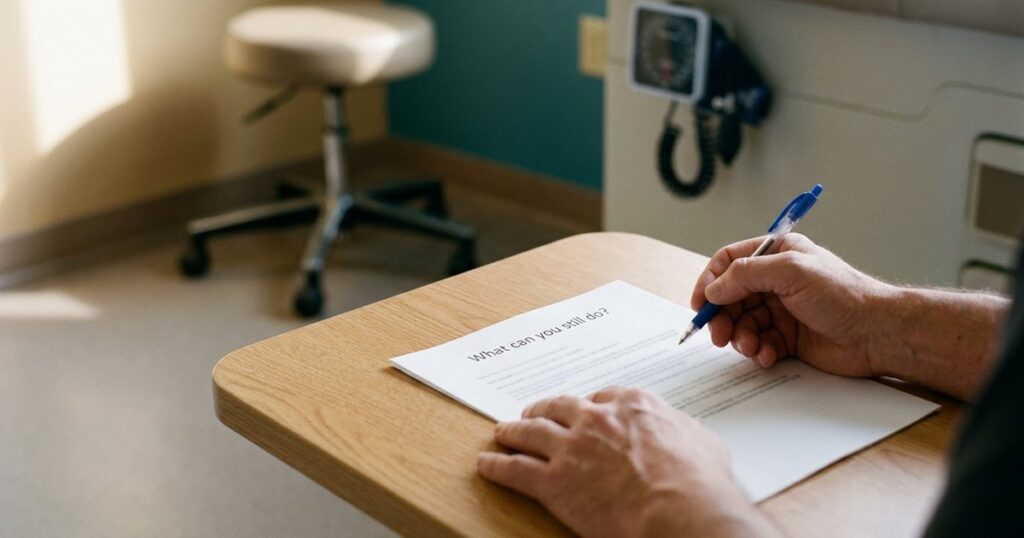
Somebody told you a disability claim comes down to your chart. They were mostly right. Social Security decides on paper, and once you sign one authorization form, the agency requests your medical records for disability claim review from every provider you name. Your own job is narrower than most people expect. Name every source, hand over the copies you already have, and make sure the chart says something about what you can and cannot do all day. Those access rules are the ones in our guide to how to get your old medical records in Ohio, and they still work in your favor.
What Social Security actually counts as evidence
Federal rules sort evidence into five buckets, and knowing the names helps you ask for the right thing. Objective medical evidence means medical signs, laboratory findings, or both. Think imaging, labs, the range-of-motion numbers a physical therapist wrote down. A medical opinion is something else: a statement from a medical source about what you can still do despite the impairment. Other medical evidence covers the rest of what a provider writes: history, clinical findings, diagnosis, treatment tried, prognosis.
Bucket four is evidence from nonmedical sources, including your own account of a bad day. Bucket five covers findings a reviewer made earlier in the same claim.
What most files are missing is the medical opinion. A diagnosis establishes that something is wrong. It does not establish that you cannot hold a job. Regulations name four areas an opinion should speak to. Physical demands: sitting, standing, walking, lifting, carrying, pushing, pulling. Mental demands: concentration, persistence or pace, remembering instructions, responding to supervision and work pressure. Sensory demands such as seeing and hearing. Adapting to conditions like temperature extremes or fumes. If nothing in your chart touches those four, a strong diagnosis is doing half the work.
How far back your records have to go
Here is the rule almost nobody mentions. Before Social Security can decide you are not disabled, it must develop your complete medical history for at least the twelve months before the month you filed. Say your disability began more recently, and it develops from the month you name instead, unless there is reason to think the problem started earlier.
Read that as a priority list. Your last year of treatment is the case. Older material is context, and it counts most when it shows the same problem running back in time, or holds a test nobody has repeated since. A 2016 hospital stay will not decide a 2026 claim. Worth knowing before you chase a decade-old chart.
Who actually requests medical records for disability claim decisions
That form is called SSA-827, the Authorization to Disclose Information to the Social Security Administration. Social Security and the state agency use it to get what they need. By its own count, the agency sends more than 14 million requests on claimants’ behalf each year, each carrying a signed 827.
Three things about it are worth knowing. It authorizes a class of sources rather than a list, so a provider’s name need not appear on it. A few states and some providers insist on being named, and then you may sign one authorization per source. It runs for twelve months from the date you sign, covering records created in those twelve months along with everything before. You can revoke it in writing at any time, though whatever was released stays released.
If you live in Mahoning County, the medical side of your claim is not decided in Youngstown. Ohio’s determinations come from the Division of Disability Determination at Opportunities for Ohioans with Disabilities, which runs out of Columbus. Mail goes to PO Box 359001, Columbus OH 43234-9001, and the line is 866-776-3192.
OOD does keep a Youngstown office, on the fourth floor of the George Voinovich Government Center at 242 W Federal St. It serves Columbiana, Jefferson, Mahoning and Trumbull counties. Ohio’s own office list does not identify it as a disability determination office. So do not drive downtown with paperwork expecting to hand it to whoever decides your case. Call first and ask where the file sits.
The request clock, and when to chase records yourself
Requests for medical records for disability claim files go out on the agency’s clock, and the regulation spells that clock out. Social Security makes one initial request to the provider, or to whoever holds the provider’s records. If nothing arrives, it makes a single follow-up between ten and twenty calendar days later. That provider then gets at least ten more calendar days to answer.
Do the arithmetic: five or six weeks from the first request before silence means anything. Past that, get your own copy. You have a federal right to it, set out in our walkthrough of your HIPAA right of access, and what a provider may charge is capped, which we cover in what Ohio providers can charge for records. Filing is never gated on having the chart in hand. Apply, then feed the file.
When the hospital holding your records is gone
This is the Mahoning Valley version of the problem. Thousands of people on the north side of Youngstown were treated at a hospital that shut in September 2018, and its charts went into storage during a bankruptcy. Our page on requesting Northside Regional Medical Center records lays out where they went and why the usual route dead-ends. A wider picture sits in what happened to Steward Health Care records after the bankruptcy. For contact history, see our page on Northside hospital medical records.
For a disability claim, a closed provider is less fatal than it feels, because the rules anticipate it. Social Security may buy a consultative examination at its own expense when the evidence it needs is missing from your providers’ records. It may do the same when evidence cannot be obtained for reasons beyond your control, including the death or noncooperation of a medical source. A warehouse that ignores letters fits that description.
Your part is documenting the attempt. Keep dated copies of every request you sent and every non-answer you got, then tell the agency in writing which source is unreachable and what you tried. An unexplained hole in the record reads as a gap in treatment, which hurts you. A hole with a paper trail reads as what it is. Continuing a claim for a relative who died? You will need a death certificate too, and ordering one in Mahoning County is worth starting early.
What to do first, and what to skip
Most people collecting medical records for disability claim evidence start in the wrong place. Start with the list of sources instead. List every provider from the past two years: name, address, phone number, rough dates you were seen, and any patient number off an old statement. Incomplete source lists are the usual reason a decision rests on half a chart.
Then ask one provider for an opinion covering the four ability areas above. Pick whoever knows you best and has seen you most often. Ask for documentation, not a conclusion about whether you are disabled. That call belongs to the agency, and a letter that only asserts it carries little weight.
Skip two things. Do not mail your whole file in bulk, because duplicates bury the two or three documents that matter. And do not stop treatment while you wait, since a gap in care reads as improvement.
Frequently asked questions
Does Social Security get my medical records for me?
Yes, for the sources you name. After you sign form SSA-827, it requests records from your providers and makes one follow-up if the first goes unanswered. Bring whatever copies you already have; those land in the file immediately instead of in six weeks.
Do I have to pay for medical records for a disability claim?
Not for the ones Social Security requests itself. Order copies on your own and a provider may charge a reasonable fee. It cannot be a per-page fee when the records are stored electronically, and you cannot be refused access over an unpaid medical bill.
What if the doctor or hospital I saw has closed?
Send a written request anyway, to whoever holds the records now, and keep the dated copy. Then tell Social Security which source is unreachable. Social Security can pay for a consultative examination when evidence cannot be obtained for reasons beyond your control, and a closed provider is one of them.
What if my doctor will not fill out a form?
Plenty will not, and it is rarely a judgment about your case. Regular treatment notes describing real limits can carry the point on their own. Ask at your next visit that the specifics go in the chart: how long you can sit, how much you can lift, how many days you missed. Notes written at the time often read better than a form filled in later.
How we put this guide together: the rules above come from the federal regulations and official Ohio sources listed below, read directly and checked on the review date. This site is independent and not affiliated with any hospital, insurer, or government agency. It’s general information, not medical, legal, or insurance advice. Social Security’s national line is 1-800-772-1213 (TTY 1-800-325-0778). For an emergency, call 911.
Sources
- 20 CFR 404.1512, responsibility for evidence
- 20 CFR 404.1513, categories of evidence
- 20 CFR 404.1519a, when Social Security will purchase a consultative examination
- Social Security Administration, Form SSA-827 information page
- Opportunities for Ohioans with Disabilities, office locations
Last reviewed: November 18, 2026