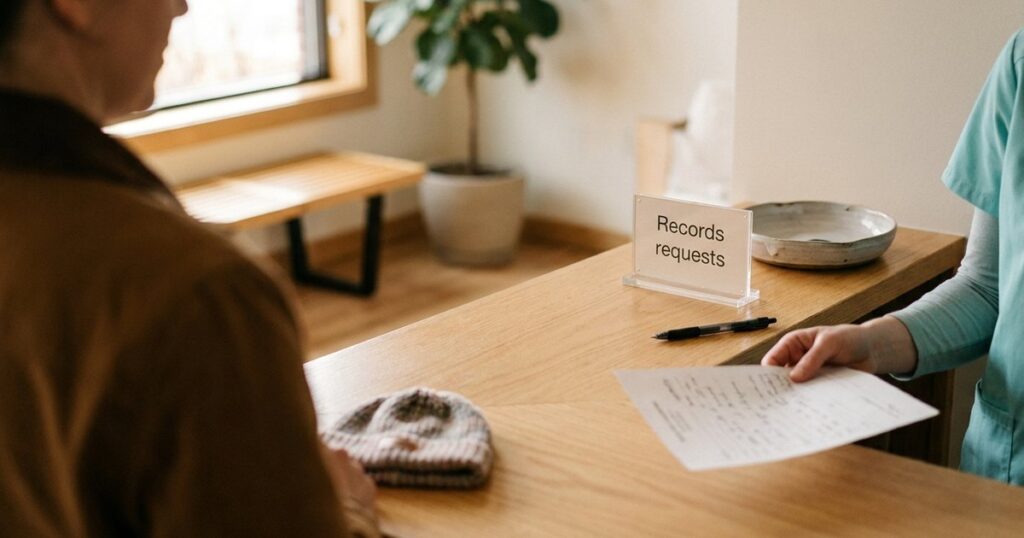
The school needs a shot record by Friday. A new specialist in Boardman wants the pediatric chart before the first visit. Or you moved out last spring and the other parent has stopped forwarding anything. Whatever brought you here, the rules for medical records for minor Ohio patients are mostly settled, and they usually favor the parent asking.
A parent is normally treated as the child’s stand-in, so you ask the way an adult patient would. For the request itself, see our walkthrough on getting your medical records in Ohio. What changes when the patient is a kid is who can be told no, and when.
Who can request medical records for minor Ohio patients
Two bodies of law stack here, and they mostly agree. Under the federal privacy rule, a parent, guardian, or person acting in loco parentis is generally the minor’s “personal representative,” because that person usually has authority to make health decisions for the child. HHS guidance on personal representatives says so, and cites 45 CFR 164.502(g).
Ohio says the same in its own words, which helps when a front desk wants a citation. Revised Code 3701.74 defines a “patient’s personal representative” to include “a minor patient’s parent or other person acting in loco parentis.” It also sets what the paperwork looks like:
- The request must be written, signed, and dated no more than one year before you hand it in.
- It must say where the copy goes: to you, to a provider you name, or held at the office.
- The provider must take reasonable steps to confirm who you are. Bring ID and something tying you to the child, usually a birth certificate or custody order.
- If you only want to look, the office must let you examine the record during business hours at no charge.
On timing, the Ohio statute says only that a provider acts “within a reasonable time.” The federal clock is the one with teeth, and we cover it in the guide to your HIPAA right of access. If the office never furnishes the record, 3701.74 lets a personal representative bring a civil action. Most people never get there. A dated written request and one follow-up call clears the great majority of requests for medical records for minor Ohio patients.
What a provider can keep from you, legally
The privacy rule names three situations where the parent is not the personal representative. One: state law lets the minor consent to that service alone, and the minor did. Two: someone else, such as a court, is authorized to consent and does. Three: the parent agreed to a confidential relationship between the child and the provider. That third one catches people. The pediatrician who asked whether she could talk with your 16-year-old alone was asking for exactly that.
A provider may also decline to treat someone as a personal representative if it reasonably believes that person has abused or neglected the child, or that treating them as the representative could endanger the child. A licensed professional makes that call, not the records clerk.
Ohio fills in the first exception with real numbers:
- Outpatient mental health, age 14 and up. Revised Code 5122.04 lets a minor 14 or older ask for outpatient mental health services, not medication, without a parent’s consent or knowledge. It caps out at six sessions or thirty days, whichever comes first. After that the professional either stops or, with the minor’s consent, contacts a parent.
- Sexually transmitted infections. Revised Code 3709.241 lets a minor consent to diagnosis or treatment of an STI. No parental consent is required, and the section sets no minimum age.
- Drug and alcohol treatment. Revised Code 3719.012 does the same for a condition a physician reasonably believes was caused by a drug of abuse or alcohol.
Each of those statutes also says a parent isn’t liable for the bill for care they didn’t consent to. If a bill shows up for a visit nobody told you about, that is the thread to pull.
The carve-outs on Ohio’s records statute
Almost nobody mentions this. Division (D) of 3701.74 lists record types the statute doesn’t cover at all, among them records governed by Chapter 5122, Ohio’s mental health law, and records under the federal substance use confidentiality rule at 42 CFR part 2. So the clean process above is not the process for your teenager’s counseling notes. Say which visits you want when you call, and ask whether any of it sits in a separate protected set.
If you’re divorced or separated
Ohio handles this better than most states. Under division (H) of Revised Code 3109.051, a parent who is not the residential parent is entitled to any record related to the child on the same terms as the residential parent. The exception is a court finding that access isn’t in the child’s best interest, put in a written order. “Record” there expressly covers records kept by hospitals and other medical providers, and by schools.
The enforcement language is the part to know. A record keeper who knowingly fails to comply with that division, or with the court’s order, is in contempt of court. The residential parent can narrow your access only by showing a limiting order that applies to that record. So bring the decree, not just your word for it.
Grandparents and other relatives raising a child
Plenty of kids in the Mahoning Valley are raised by a grandmother or an aunt with no custody case. Revised Code 3109.66 sets out the caretaker authorization affidavit. Signed and notarized, it authorizes a grandparent to consent to medical, psychological, or dental treatment, and it must be filed with the juvenile court within five days. It doesn’t give legal custody, and a parent’s contrary decision overrides it unless that decision would jeopardize the child’s life, health, or safety. A power of attorney under Revised Code 3109.52 works similarly.
Neither one, read on its face, says anything about handing over records. They are consent documents. Many offices accept an affidavit as proof you stand in the parent’s place, and the federal “in loco parentis” language supports that. Others want a guardianship order. Ask before you drive over.
School and shot records are a separate system
If what you need is an immunization record or the school nurse’s file, you may be at the wrong building. Records a school holds run on FERPA, not the medical privacy rule. Under 34 CFR 99.10, a school must comply with a parent’s request to inspect records within a reasonable period, and not more than 45 days. Those rights pass to the student at 18.
If the care was at Northside or a clinic that closed
Childhood care around here often sits inside an organization that no longer exists. Northside Regional Medical Center closed in September 2018, and clinics in the building ran until Steward’s 2024 bankruptcy. A parent’s right to the record doesn’t expire with the hospital, but finding the custodian is the hard part. Start with what we’ve confirmed about Steward Health Care medical records, then our page on Northside hospital medical records. If a release company holds the file, expect a quoted price, and see our breakdown of medical records fees in Ohio.
If your child was treated anywhere that has since changed hands, request a copy while you can still name the practice.
How we put this guide together: we worked from the Ohio Revised Code sections and federal sources listed below, checked each on November 15, 2026, and left out anything we couldn’t verify there. This site is independent and isn’t affiliated with any hospital, health system, insurer, or government agency, including the former Northside Regional Medical Center, Steward Health Care, or Mercy Health. This is general information, not medical, legal, or insurance advice. In an emergency, call 911.
Frequently asked questions
Do parents always have the right to see a minor child’s medical records?
Nearly always. A parent asking for medical records for minor Ohio patients is generally the child’s personal representative and can request the chart. The exceptions are narrow: care the minor legally consented to alone, care consented to by a court, a confidential relationship the parent agreed to, and cases where release could endanger the child.
At what age can a teenager in Ohio control their own records?
There’s no single age. Ohio ties it to the type of care. A minor 14 or older can get limited outpatient mental health services alone, six sessions or thirty days. Minors can consent to STI and drug or alcohol treatment with no stated minimum age. Records of care a minor consented to alone are the ones a parent may not see. Full control arrives at 18.
Can a parent who doesn’t have custody request the records?
Yes. Ohio law entitles a parent who is not the residential parent to the same access as the residential parent, unless a court order says otherwise. Bring the parenting order. A record keeper who knowingly ignores that is in contempt of court.
What should I do if a provider refuses?
Ask for the reason in writing, and ask which record set the refusal covers. Some denials are really about a carve-out, like mental health records, rather than your standing as a parent. If it’s a flat refusal to furnish the record, Ohio’s statute allows a civil action.
Sources
All sources checked November 15, 2026.
- HHS Office for Civil Rights, Personal representatives
- Ohio Revised Code 3701.74
- Ohio Revised Code 3109.051
- Ohio Revised Code 5122.04
- Ohio Revised Code 3709.241
- Ohio Revised Code 3109.66
- 34 CFR 99.10
Last reviewed: November 15, 2026