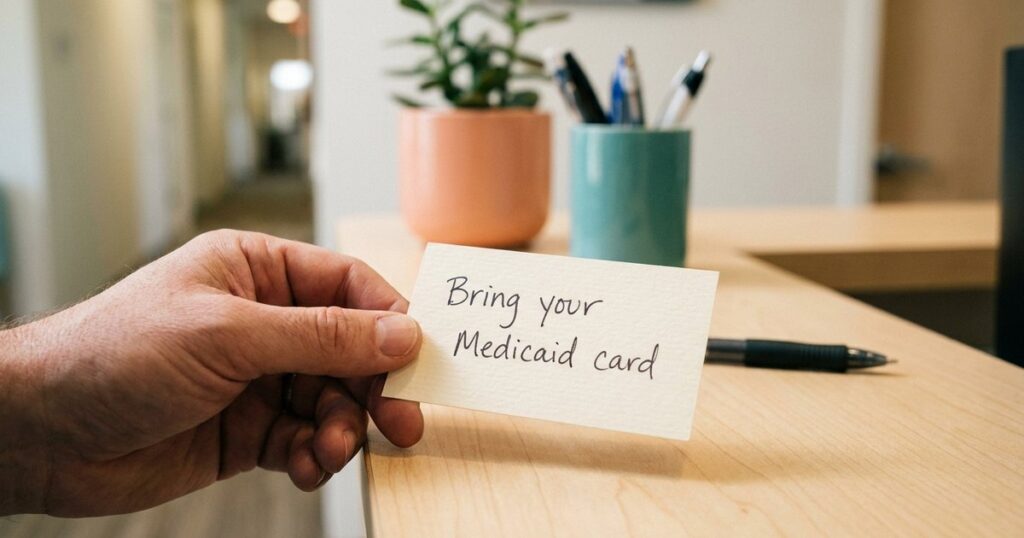
You have an Ohio Medicaid card, a toothache or an overdue cleaning, and a phone book’s worth of dental offices that may or may not want your coverage. Finding dentists that accept Medicaid in Ohio is mostly a matter of knowing which list to trust and what to say when you call. Start with your health plan’s dentist search, filter for offices taking new patients, then phone the office and confirm they take your exact plan before you book.
That’s the short version. Below is the longer one for Youngstown and the Mahoning Valley: what Ohio Medicaid pays for, how the plans and their dental companies fit together, a call script, and where to go if the directory comes up empty. If you want a starting list of local offices first, our page to find a dentist in Youngstown is the place for that. Come back here to check who takes what.
What Ohio Medicaid dental coverage includes
Ohio’s Department of Medicaid publishes a short benefits chart for dental care, and it applies to adults and kids alike for most services. Checkups and cleanings, fillings, extractions, crowns, root canals, dentures, and medical or surgical dental services are all on it. Some come with strings attached.
Here’s what the state’s chart says (Ohio Department of Medicaid: Dental):
- Checkups and cleanings: every 180 days for people under 21, every 365 days for people 21 and older.
- Fillings, extractions, crowns and root canals: based on medical necessity. Some need approval from the State first.
- Dentures and partials: need prior authorization from the State. Replacement depends on medical necessity.
- Braces: for people under 21 only, and only in extreme cases, with prior authorization.
- Copay: $0 under 21. For adults 21 and older, up to $3 per visit. The chart carves out exceptions for pregnant adults and people living in a nursing facility or intermediate care facility.
Notice the gap that trips people up. The state chart says adults get a checkup once every 365 days. Some plans advertise more. Humana’s Ohio Medicaid page says members 21 and older can have two cleanings a year, and Buckeye’s says two exams and cleanings a year. The plan’s own handbook is what your dentist’s billing office will actually follow, so read it, or ask them what your plan allows before you book a second cleaning.
Kids get more generous treatment. Anyone under 21 has dental care folded into Ohio’s Healthchek program, and the state lists no copay for them. We cover the child side in more detail in our guides for the Mahoning Valley, but the short rule is: if you’re a parent, you have more options than you’d have as an adult, so don’t assume the adult limits apply to your child.
How the plans and dental companies fit together
Ohio Medicaid’s managed care program has seven plans: AmeriHealth Caritas, Anthem Blue Cross and Blue Shield, Buckeye Community Health Plan, CareSource, Humana Healthy Horizons in Ohio, Molina Healthcare of Ohio, and UnitedHealthcare Community Plan of Ohio (Ohio Medicaid Managed Care).
Here’s the part nobody tells you. A plan often hands its dental benefit to a separate dental company. Humana’s page, for example, says its Ohio Medicaid dental coverage runs through DentaQuest, and tells you to call the dentist and say you have Humana Healthy Horizons Ohio Medicaid with DentaQuest. So when a front-desk person asks “which plan?”, you need both names. Your member ID card, or the dental page on your plan’s website, will show who runs your dental side.
Why it matters: an office might be in the network for one plan’s dental company and not another’s. “We take Medicaid” and “we take your Medicaid” are different sentences.
Dentists that accept Medicaid in Ohio: how to find one near Youngstown
- Get your card out. Note the plan name and the member services number on the back.
- Open your plan’s “find a dentist” tool. On Humana’s, for example, you type an address or ZIP code, pick a distance, choose Medicaid, then choose the adult or children’s plan. Use your own ZIP code.
- Filter for “accepting new patients” if the tool offers it. Humana’s does, along with filters for specialty and languages.
- Write down three or four offices. Don’t stop at one.
- Call each one and ask the questions in the next section.
- If the directory is wrong or empty, call member services on your card and ask them to find an in-network dentist for you. Humana’s page invites exactly that.
Say you’re on the north side, you’re on a plan whose dental benefit sits with a separate company, and your first call turns up “we stopped taking that last year.” That happens. Directories lag behind reality, which is why step 5 matters more than step 2. Treat any online list as a lead, not a promise.
What to ask when you call
Keep it quick and specific. You’ll get a straighter answer.
- “Do you take Ohio Medicaid through [your plan name], dental through [dental company]?”
- “Are you taking new adult patients?” (Or children, if that’s who the visit is for.)
- “How long is the wait for a first appointment?”
- “Is there a copay at the visit?” For most adults it’s up to $3.
- “If I need a denture, partial or crown, do you handle the prior authorization?”
- “What happens if I miss an appointment?” Ask so you know the rules before you need them.
Ask for the office name, the date and the name of the person you talked to in your notes. If a billing surprise shows up later, that note helps.
When the Medicaid dentist search comes up short: community health centers
Federally supported community health centers are built for this situation. Under the federal rules, they serve everyone, even people who can’t pay, and adjust fees by income and family size (HRSA: What is a health center?). HRSA also runs a health center finder at findahealthcenter.hrsa.gov where you can type in your ZIP code.
In Youngstown, ONE Health Ohio runs a dental clinic at 726 Wick Avenue, 44505. Its dental page lists screening exams, cleanings, extractions, X-rays, tooth-colored fillings, preventive care, orthodontic evaluations and dental emergencies, with the phone number 330-747-9551. Hours are Monday, Tuesday, Wednesday and Friday from 8 a.m. to 5 p.m., and Thursday from 9 a.m. to 6 p.m. (ONE Health Ohio: Dental Care).
The clinic’s payment page says it accepts Medicaid, Medicare and most private insurance, and has a sliding fee scale for uninsured and underinsured patients, which requires an application and proof of income (ONE Health Ohio: Payment Information). We checked both pages on October 16, 2026.
One more local thing, because readers of this site often ask about the old Northside campus. In May 2019, ONE Health Ohio announced a Northside Dental Center at 500 Gypsy Lane, in Medical Building A. The current dental page lists only the Wick Avenue site, so we can’t tell you whether that location is still open. Call before you drive over. ONE Health Ohio is its own organization and is not connected to this site or to the former hospital.
If your plan’s dentist network is the problem
Maybe every office near you is full, or the only in-network dentists are an hour away. You have options, and the calendar matters right now. Ohio Medicaid’s annual plan open enrollment runs November 1 through November 30, and a change takes effect on the first day of the month after you choose. Outside that window, you can ask to switch if you have a “just cause” concern about access to health care, and you can change within your first 90 days on a plan. To choose or change, call the Ohio Medicaid Consumer Hotline at 800-324-8680 (TTY 711) (Ohio Medicaid Managed Care).
Say it’s October 16 and you’ve spent a month failing to find a dentist in your plan’s network. Don’t switch blind. First check the other plans’ dentist directories for offices near you that are taking new patients, and call those offices to confirm. A plan that looks better on paper is useless if the dentist you want isn’t in it. Then use the hotline to make the change.
Common mistakes that cost people appointments
Showing up with the wrong card is the big one. If you’ve changed plans since your last visit, tell the office, because the old plan’s dental company won’t pay.
Another is assuming a denture or partial plate is just a visit. The state says both must be prior authorized. Ask the office to confirm approval is in place before they start work, so a bill doesn’t land on you later.
People also skip the dentist because the last office dropped them, then end up in an emergency room with a swollen face. A hospital emergency room can treat pain and infection but usually can’t fix the tooth. If you have facial swelling that’s spreading, a fever, or trouble breathing or swallowing, call 911. For a toothache without those signs, call a dental office first and say the word “emergency.”
What to bring to the first visit
A new-patient visit goes faster with a little prep. Bring your Medicaid card and your plan’s card if it’s separate, a photo ID, and a list of your medications. If you have X-rays from a previous dentist, ask that office to send them over, since it can save you from paying (or your plan from paying) for new ones. Arrive early, because new patients usually fill out forms. And tell the front desk up front if you’re nervous about the chair. A good office would rather know.
Plan on the first appointment being an exam and X-rays, not the fix itself. A big problem, like several bad teeth, usually means a treatment plan and several visits, and some of that work may need approval first. Get the plan in writing.
What this guide can’t promise
We can’t tell you which individual dentist is taking new Medicaid patients this week. Nobody can, because offices change. The only list that counts is the one you build yourself with phone calls, and the best check is the office saying “yes, we take that plan” out loud.
Frequently asked questions
Does Ohio Medicaid cover dental care for adults?
Yes. The Ohio Department of Medicaid’s dental chart lists checkups and cleanings, fillings, extractions, crowns, root canals and dentures for Medicaid beneficiaries, with some services needing prior authorization. Adults 21 and older may owe a $3 copay per visit, with exceptions for pregnant adults and nursing facility residents.
How do I find dentists that accept Medicaid in Ohio?
Use the dentist search on your Medicaid plan’s website, filter for offices taking new patients, then call to confirm they take your specific plan and its dental company. If the directory fails you, call the member services number on your ID card and ask for help finding an in-network dentist.
How often will Ohio Medicaid pay for a cleaning?
The state’s chart says every 180 days for people under 21 and every 365 days for people 21 and older. Some plans advertise two cleanings a year for adults, so check your plan’s handbook or ask the dental office.
Can I get low-cost dental care in Youngstown if I can’t find a Medicaid dentist?
Community health centers charge on a sliding scale based on income and serve people who can’t pay. ONE Health Ohio’s Youngstown dental clinic at 726 Wick Avenue accepts Medicaid and offers a sliding fee scale with an application and proof of income. Call 330-747-9551 to ask about new patient openings.
Guides in this series
- what to do in a dental emergency at night
- doctors accepting new patients in Youngstown
- how to choose a pediatric dentist in Youngstown
- free and low-cost clinics in Youngstown
- children’s dentists that take Medicaid in the Mahoning Valley
How we put this guide together
We built this guide from the official sources listed below and reviewed it on October 16, 2026. Clinic details come from each organization’s own pages and may change, so call before you go. This site is independent. We’re not affiliated with Northside Regional Medical Center, ONE Health Ohio, any hospital, dental company, insurer or government agency. This is general information, not medical, legal or insurance advice. In an emergency, call 911.
Sources
- Ohio Department of Medicaid: Dental
- Ohio Medicaid Managed Care: Individuals
- ONE Health Ohio: Dental Care
- ONE Health Ohio: Payment Information
- HRSA: What is a health center?
Last reviewed: October 16, 2026