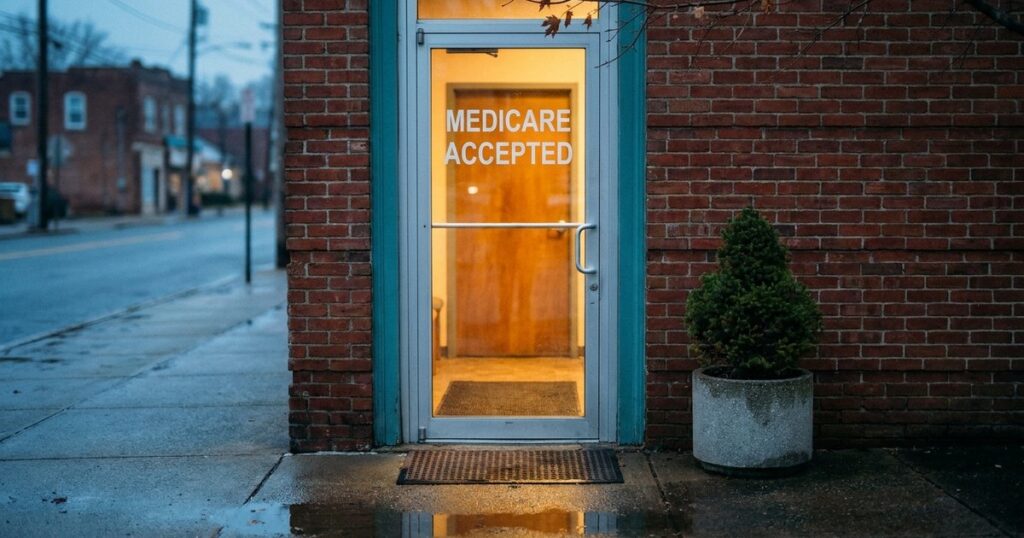
It’s Saturday afternoon, your throat is on fire, and your doctor’s office doesn’t open until Monday. So, does Medicare cover urgent care? Yes. Part B treats a walk-in visit for a sudden illness or injury as “urgently needed care,” and pays its share as it would for any provider visit. Cost is the interesting part: the same sore throat can produce two very different bills depending on which clinic door you walk through. If you’re weighing coverage for next year, our guide to how Ohio’s Medicare Advantage plans compare covers the network rules that follow from that choice.
Does Medicare cover urgent care under Part B?
Medicare.gov is blunt about what qualifies. Urgently needed care treats “a sudden illness or injury that isn’t a medical emergency and/or life threatening” (Medicare.gov). A twisted ankle. An overnight rash. Pink eye, an earache, a urinary infection, a cut that might need stitches. Part B covers the visit, the exam and the services the clinic performs, and with Original Medicare you need no referral.
The clinic does have to accept Medicare. Most walk-in clinics in the Mahoning Valley do, because a hospital system runs them. A small independent clinic is worth one phone call first.
Medicare urgent care copay: what you pay in 2026
Once you’ve met the Part B deductible, you pay 20% of the Medicare-approved amount for the provider’s services. The 2026 deductible is $283. It rises to $292 in 2027 (Medicare.gov). It also resets every January 1, which matters more than people expect.
Say the approved amount for a routine visit lands at $140. Cleared your deductible back in April? Your share is $28. Walk in on January 3 instead, before you’ve spent a dollar that year, and you pay the whole $140. It counts toward the new deductible, but it still leaves your pocket. Same visit, five times the price, decided by the calendar.
A Medigap policy changes that arithmetic, since most standardized plans pay some or all of the 20%. Check your plan’s benefit chart. Still on a job plan at 65? Which insurer pays first also changes your share, and we cover that in our guide on how Medicare works alongside employer coverage.
The hospital copayment nobody warns you about
Here’s the part that generates angry phone calls. Medicare says the same outpatient care can cost more in a hospital outpatient department than in an independent doctor’s office. There you owe the hospital a copayment for each service, on top of the 20% you owe the provider (Medicare.gov). That isn’t a loophole. It’s how outpatient billing works, and it applies to clinics that look like ordinary storefronts. So does Medicare cover urgent care at a hospital-run clinic? Yes, with a second charge attached.
Two things keep it from running away. In most cases the copayment can’t exceed the Part A deductible for each service, which is $1,736 in 2026 and $1,776 in 2027. The exception is a critical access hospital, where your copayment may be higher and may pass that ceiling. Those are small rural facilities, so it’s worth asking if you’re getting care out in a rural county.
One question at the front desk settles it. Is this clinic billed as a hospital outpatient department? If yes, expect a facility charge alongside the provider’s fee, and ask roughly what it runs. Staff may not quote an exact number, but they can usually give a range.
Medicare urgent care coverage on an Advantage plan
Does Medicare cover urgent care differently on an Advantage plan? In practice, yes. Your plan sets the copay instead of Medicare, usually a flat amount per visit. Often that’s simpler, and sometimes cheaper. The network is the catch, and the rule is narrower than most summaries let on.
Medicare’s official booklet on Advantage plans says an HMO covers emergency care and out-of-area urgent care, whether you get it inside the plan’s network or outside it (CMS, April 2026). Read that phrase again: out of area. Drive to an out-of-network clinic across town while you’re home in your own service area, and you’re outside that protection. The booklet warns that non-emergency care outside the network without authorization can leave you paying the full cost. PPO members have more room, because a PPO covers emergency and urgent care anywhere, with out-of-network visits generally costing more.
A local wrinkle to check before January
If your Advantage plan comes from Medical Mutual of Ohio, spend ten minutes on this. Mercy Health’s contract with Medical Mutual expires December 31, 2026. Mercy says it stays in network through that date, but that beginning January 1 its Ohio physicians, hospitals and care sites may fall out of network for Medical Mutual commercial, Medicare Advantage and Exchange members if no new agreement is reached, with higher out-of-pocket costs or reduced coverage for non-emergency care (Mercy Health, updated Nov. 17, 2026).
Mercy runs most of the walk-in clinics near Youngstown. A routine January walk-in is exactly the visit this would touch. Contracts like this often settle days before the deadline, so check where it stands. Call the number on your card about your own benefits.
Medicare emergency room coverage and the three-day rule
Part B usually covers emergency department services. You pay a copayment for the visit, a copayment for each hospital service you receive, and 20% of the approved amount for the doctor’s work after the deductible. There’s a useful break built in. If a doctor admits you to the same hospital for a related condition within three days of the ER visit, you don’t owe those copayments, because Medicare counts the visit as part of your inpatient stay. The same page notes that Medicare covers emergency care outside the United States only in rare situations (Medicare.gov).
Worth remembering if you’re sent home and then admitted a day or two later. We go through the clinic-or-ER decision symptom by symptom in our guide on when to pick the emergency room over a walk-in clinic. If something could threaten your life, a limb or your eyesight, call 911.
Check the bill before you pay it
Original Medicare mails a Medicare Summary Notice every six months for any period in which you used services. It shows what was billed, what Medicare paid, and the maximum you may owe (Medicare.gov). Keep the clinic’s receipt and compare. See a service you never received? Call the clinic’s billing office first, because a resubmitted claim clears up most of it. If the decision itself looks wrong, the last page of the notice gives step-by-step appeal instructions. Odd charges are also how fraud surfaces, and we cover the patterns in our guide to spotting and reporting Medicare scams in Ohio.
Where to go around Youngstown
Northside Regional Medical Center closed in September 2018. The north side has had no emergency room of its own since. For a walk-in visit, the closest Mercy Health clinics sit on Belmont Avenue and Wick Avenue, with others in Austintown and North Lima. Our page on urgent care in Youngstown and Boardman carries the current addresses and phone numbers. St. Elizabeth Boardman Hospital on Market Street runs a 24-hour emergency department.
For anything that could wait a few days, your own doctor costs less and knows your history; we keep a list of local practices accepting new patients. Coverage questions go to 1-800-MEDICARE (1-800-633-4227), or to OSHIIP for free counseling from someone with nothing to sell you.
How we put this guide together
We researched this guide from the official sources listed below and checked every figure against them on the review date. Anything we couldn’t verify there was left out. This site is independent and not affiliated with Northside Regional Medical Center, Steward Health Care, Mercy Health, any insurer or any government agency. Nothing here is medical, legal or insurance advice, and we don’t rank or recommend specific plans or carriers. In an emergency, call 911.
Questions people ask about Medicare and urgent care
Does Medicare cover emergency room visits?
Yes. Part B usually covers emergency department services. You pay a copayment for the visit and one for each hospital service, plus 20% of the Medicare-approved amount for the doctor’s services after the Part B deductible. If you’re admitted to the same hospital for a related condition within three days, those copayments drop off and the visit becomes part of your inpatient stay.
Does Medicare cover walk-in clinic visits the same way?
A walk-in visit for a sudden illness or injury falls under the same Part B rules as any urgent care visit. What varies is the billing. If the clinic operates as a hospital outpatient department, you’ll owe a hospital copayment on top of the 20% coinsurance for the provider’s services.
With a Medicare Advantage HMO, do I need a referral for urgent care?
Generally no. HMO plans cover emergency care and out-of-area urgent care in or out of network. Inside your own service area, though, a non-emergency visit to an out-of-network clinic without authorization can leave you paying the whole bill. Use an in-network clinic when you’re close to home, and check your plan’s rules.
Will Medicare pay for a prescription the urgent care writes?
Not under Part B, which generally doesn’t cover self-administered drugs you take home. Prescriptions go through your Part D drug plan. Fill them at a pharmacy in that plan’s network to pay the plan’s copay rather than the cash price.
How do I find an urgent care near Youngstown that takes Medicare?
Call the clinic and ask two things: do you accept Medicare, and are you billed as a hospital outpatient department? On an Advantage plan, check the plan’s provider directory or the number on your card, since the network decides your cost. Our local urgent care page lists the nearby clinics with current phone numbers.
Sources
- Medicare.gov: Urgently needed care coverage
- Medicare.gov: Outpatient hospital services
- Medicare.gov: Emergency department services
- Medicare.gov: Medicare costs for 2026 and 2027
- CMS: Understanding Medicare Advantage Plans
- Medicare.gov: Medicare Summary Notice
- Mercy Health: Medical Mutual of Ohio updates
- Ohio Department of Insurance: OSHIIP
Last reviewed: November 24, 2026