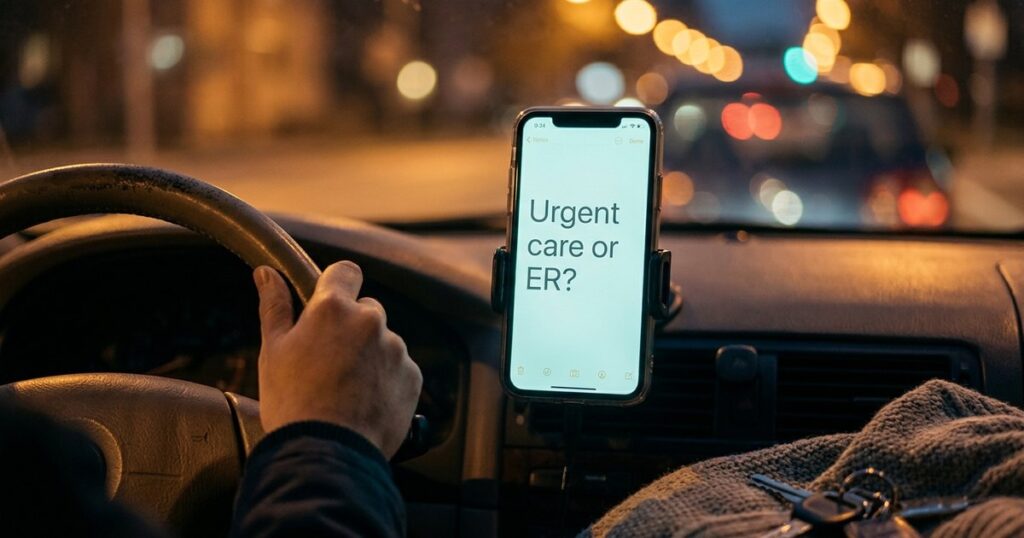
It’s 9 p.m., your kid’s ear hurts, or you’ve twisted an ankle on the porch steps, and your regular doctor’s office is dark. The urgent care vs emergency room question comes down to one thing: is this a threat to life, a limb or your eyesight? When it might be, call 911. If it’s miserable but stable, urgent care is usually faster, simpler and far cheaper.
That’s the quick rule. The rest of this guide is for the gray zone in between, and for the Youngstown-specific wrinkle: since Northside Regional Medical Center closed in September 2018, the north side has had no emergency room of its own. We’ll cover where to go, what it costs, and what to do if you picked wrong. Need a walk-in clinic? Our page on urgent care in Youngstown and Boardman lists the nearby ones.
Urgent care vs emergency room: the one-minute test
Ask yourself three questions, in this order.
First, could this kill me or leave me disabled in the next hour? Chest pressure, trouble breathing, a face drooping on one side, a seizure, bleeding you can’t stop. Call 911. Don’t drive. Don’t wait to see if it passes.
Second, if not, does it need something only a hospital has? A CT scan, surgery, an IV drip, a specialist on call. Go to the emergency room.
Third, if not, could it wait until tomorrow’s appointment but you don’t want to wait? That’s urgent care. Think sprains, minor cuts, sore throats, rashes, pink eye, earaches, urinary infections, a fever in an otherwise healthy adult.
The American College of Emergency Physicians draws the line the same way. It says emergency departments handle severe or complex problems around the clock, while urgent care suits minor issues, especially after hours and on weekends. Its lists are worth knowing by heart (ACEP).
Which symptoms go where
Here’s a working cheat sheet. It’s built on ACEP’s lists plus CDC warning signs, and it errs on the side of caution. Torn between two columns? Pick the more serious one.
| Situation | Where to go |
|---|---|
| Chest pain or pressure, shortness of breath, fainting, signs of stroke | Call 911 |
| Uncontrolled bleeding, seizure, sudden severe headache, sudden confusion, serious head injury | Call 911 or the emergency room |
| Severe belly pain, a deformed or badly injured limb, a deep wound, a bad burn | Emergency room |
| Minor broken bone, sprain, small cut that may need stitches | Urgent care |
| Cough, sore throat, ear pain, pink eye, rash, upset stomach, urinary symptoms | Urgent care |
| Refills, ongoing conditions, check-ups, anything that can wait a few days | Your own doctor (or find one here) |
Two of those rows deserve more than a table cell, because people hesitate on them.
Heart attack signs
The CDC lists chest pain or discomfort that lasts more than a few minutes or comes and goes, feeling weak, light-headed or faint, pain in the jaw, neck, back, arms or shoulders, and shortness of breath. It also notes that unusual tiredness, nausea or vomiting are more common in women. Its advice is to call 9-1-1 immediately (CDC: heart attack). A walk-in clinic can’t do what a cath lab does, and a drive across town costs minutes you don’t have.
Stroke signs
The CDC’s list: sudden trouble walking, dizziness or loss of balance; sudden trouble seeing; sudden numbness or weakness in the face, arm or leg, especially on one side; sudden confusion or trouble speaking; and a sudden severe headache with no known cause. Call 9-1-1 right away, and don’t have someone drive you, because paramedics can begin treatment on the way. Note the time symptoms started; doctors use it to pick treatment (CDC: stroke).
Urgent care vs emergency room cost
This is where the choice hits your wallet. The Health Care Cost Institute looked at claims from people with employer-sponsored insurance. In 2022, the average urgent care visit cost $220, and the average ER visit $2,256. For a urinary tract infection, urgent care averaged $218 against $2,511 in the ER (HCCI).
Those are what insurance was billed, not what you paid. Your share depends on your plan: a copay, a deductible, coinsurance. But the ER copay on most plans is higher than the urgent care copay, and a high-deductible plan can leave you paying the full bill either way until the deductible is met. Check your card. Most list both copays on the back or in the app.
With Original Medicare, Part B usually covers emergency department services. You pay a copayment for the ER visit and for each hospital service, plus 20% of the Medicare-approved amount for the doctor’s services after the Part B deductible. There’s a useful exception: if you’re admitted to the same hospital for a related condition within three days, you don’t pay those copayments, because Medicare treats the visit as part of your inpatient stay (Medicare.gov). Questions about your own coverage go to 1-800-MEDICARE.
One more money point people miss. By law, an emergency department has to treat or stabilize anyone who comes in with an emergency, regardless of ability to pay or insurance status, according to ACEP. Urgent care centers don’t carry that legal duty, and they tend to take insurance but require payment when services are delivered. Uninsured and facing a true emergency? Don’t let the bill keep you home.
Where to go in Youngstown and the Mahoning Valley
Northside’s emergency department stopped taking patients when the hospital closed on September 20, 2018. For the backstory on how a hospital owned by a national chain ended up shuttered, our piece on what the Steward bankruptcy meant for Youngstown and Warren walks through it. For today’s purposes, here’s what’s open. Our hospitals in Youngstown page has the full list; these are the ones with emergency departments:
- Mercy Health St. Elizabeth Youngstown Hospital, 1044 Belmont Ave., 330-746-7211. Open around the clock and about a mile and a half from the old Northside building, so it’s the nearest for most north-side addresses.
- Mercy Health St. Elizabeth Boardman Hospital, 8401 Market St., 330-729-2929. A 24-hour emergency department for the south side.
- Mercy Health Austintown Medical Center, 6252 Mahoning Ave., 330-792-7418, for the west side.
- Mercy Health St. Joseph Warren Hospital, 667 Eastland Ave. SE, Warren, 330-841-4000, if you’re closer to Trumbull County.
- Akron Children’s Hospital Mahoning Valley, Beeghly campus, 6505 Market St., Boardman. Its emergency room, built for infants, children and teens, opened in April 2023 with 23 treatment rooms, according to the hospital (Akron Children’s).
Walk-in clinics are more scattered, and most are Mercy Health sites: Church Hill on Belmont Ave., downtown on Wick Ave., Austintown, North Lima, and Howland. Hours change, so call before you go. Don’t confuse a “minor emergency” or “walk-in” sign with a hospital ER. Those clinics can’t admit you, and they typically won’t have a CT scanner.
Urgent care vs emergency room for kids
Parents tend to overthink this one, and a few rules of thumb help. Trouble breathing, a seizure, a child who’s hard to wake, a serious head injury, and uncontrolled bleeding are on the same emergency list ACEP gives for adults. Call 911 or head to the nearest ER. Don’t try to sort it out with a search engine first.
For ear infections, sore throats, mild croup, pink eye and minor cuts, urgent care is usually fine. With a baby, call your pediatrician’s office first when you can, since the staff can tell you whether it can wait. Torn, with a very young child? The ER is the safer pick.
Near Boardman, the Beeghly campus ER was built for children and teens. In a true emergency, though, don’t drive past a closer hospital to reach it.
The gray zone: what people usually get wrong
Say you cut your hand cooking and it’s bleeding through a dish towel. Press hard on it. Once the bleeding stops, urgent care can look at it. Can’t get it under control? That’s the ER. Uncontrolled bleeding is on ACEP’s emergency list.
Say your 70-year-old father has a fever and seems confused. Sudden confusion is on ACEP’s emergency list, so skip urgent care and go to the ER, even though “a fever” sounds like a clinic problem.
Say you have bad stomach pain that’s been building since lunch. ACEP lists severe abdominal pain as an ER symptom, so treat it as one. Urgent care may well send you on anyway, and you’d pay for both visits.
A few other common mistakes:
- Driving yourself with chest symptoms because the hospital is “only ten minutes away.”
- Choosing the ER for convenience at 2 a.m. when urgent care opens at 8 and the problem is a stable sore throat. Waiting is fine if you’re comfortable and nothing is getting worse.
- Going to urgent care for something clearly serious just to “get checked.” You’ll lose time, and if the staff sends you to the ER, you’ll usually pay for both visits.
If urgent care sends you to the ER
It happens, and it’s not a failure on anyone’s part. Urgent care staff are trained to spot what they can’t handle. When they say go, go. Ask them to call ahead, ask whether you should take an ambulance (for chest pain, say yes), and take your visit paperwork with you. You’ll probably get billed by the clinic and the hospital separately.
What to bring either way
A photo ID and insurance card, a list of your medications with doses, your allergies, the name of your regular doctor, and a phone charger. With a chronic condition, a one-line note on your phone saying what it is helps a lot when you’re rattled. Old records from a closed hospital are a different errand, and they can wait.
Frequently asked questions
Is urgent care cheaper than the ER?
Usually, by a wide margin. In 2022 claims for people with employer insurance, the average urgent care visit cost $220 and the average ER visit $2,256, according to the Health Care Cost Institute. What you personally owe depends on your plan.
Can urgent care treat a broken bone?
Many can handle minor fractures and sprains. A serious injury, such as a deformed limb, belongs in an emergency room.
When should I call 911 instead of driving myself?
Call for chest pain, signs of a stroke, severe trouble breathing, or any time moving would make things worse. The CDC advises calling 9-1-1 for heart attack and stroke symptoms, and says not to have someone drive you with stroke signs.
Does Medicare cover emergency room visits?
Medicare Part B usually covers emergency department services. You pay a copayment for the visit and each hospital service, plus 20% of the Medicare-approved amount for the doctor’s services after the deductible. If you’re admitted to the same hospital for a related condition within three days, the copayments are waived.
How we put this guide together
We built this guide from the official sources listed below and reviewed it on October 13, 2026. Local hospital details come from each system’s own listings and may change, so call before you go. This site is independent. We’re not affiliated with Northside Regional Medical Center, Steward, Mercy Health, Akron Children’s or any hospital, insurer or government agency. This is general information, not medical, legal or insurance advice. In an emergency, call 911.
Guides in this series
- mental health crisis help in Mahoning County
- Ohio poison control: when to call, what to say, and when to call 911
- which urgent care clinics near Youngstown have X-ray
- No Surprises Act and ER bills in Ohio
- do you need stitches: urgent care or ER for cuts
- urgent care vs primary care vs telehealth
- urgent care cost without insurance in Ohio
- urgent care that accepts Medicaid in Youngstown
- urgent care for kids in Youngstown
- which urgent cares are open on Sundays in Youngstown
- how QUICKmed, Mercy and other Youngstown urgent cares compare
- St. Elizabeth Youngstown visiting hours and parking
- children’s emergency care in the Mahoning Valley
- 24-hour urgent care options in Boardman
Sources
- American College of Emergency Physicians: Emergency physicians help clarify the difference between emergency care and urgent care
- Health Care Cost Institute: Urgent care spending increased by 50% over 5 years
- Medicare.gov: Emergency department services
- CDC: Stroke signs and symptoms
- CDC: Heart attack symptoms
Last reviewed: October 13, 2026