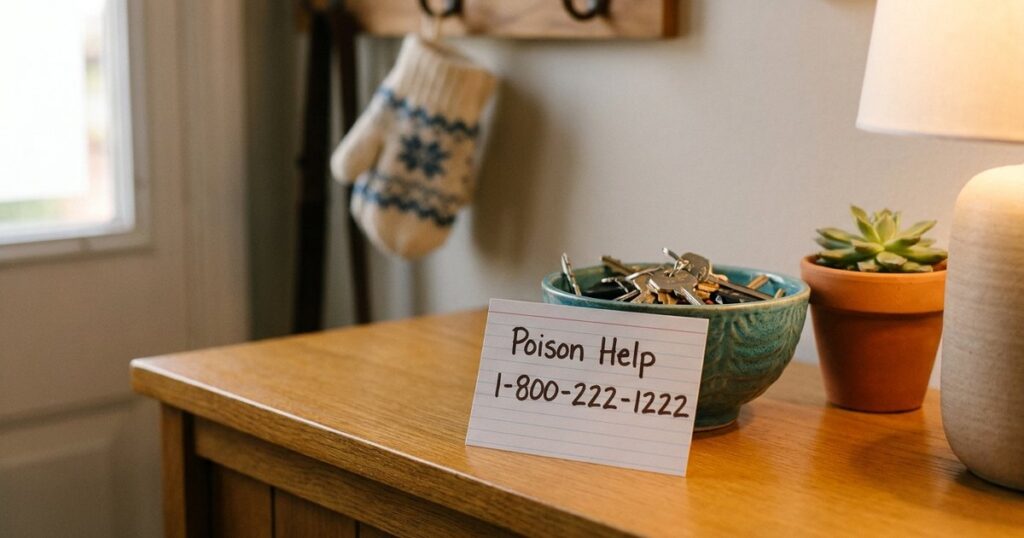
If someone in your house may have swallowed something they shouldn’t have, put the phone to your ear and call Ohio poison control at 1-800-222-1222. Do it now, before symptoms show up. Keep one exception in mind: if the person has collapsed, is having a seizure, can’t breathe well or can’t be woken, call 911 instead. Not sure where that line sits? Our guide to choosing between urgent care and the ER covers the everyday version of that decision.
Ohio poison control: the number and how the call works
There’s only one number to remember, and it’s the same one used in every state. Calls to 1-800-222-1222 get routed to the poison center that serves your region. Ohio has two, one in Columbus and one in Cincinnati, according to the Central Ohio Poison Center at Nationwide Children’s Hospital. You don’t have to work out which one you need. Routing happens automatically.
Who picks up? Pharmacists, nurses and physicians who have passed national certification exams, not a call-center script. That center says it handles more than 42,000 poison exposure calls a year and that its free, confidential advice is available around the clock. Its staff also say that working by phone with parents of young children saves more than 12,000 ER visits a year. Plenty of calls end with “you’re fine, here’s what to watch for,” and that’s a good outcome.
Poison control isn’t only for emergencies. Poison Control’s own guidance says to reach out even after a minor, unexpected encounter with a medicine, product, creature or plant.
What to have ready before you call
You can call with nothing but a phone and a worried look at the kid. Still, you’ll get the same handful of questions, and the Tennessee Poison Center, which answers the same national line, lists them. Grab what you can in under a minute:
- A phone number where they can reach you if the call drops.
- The person’s age and rough weight.
- What was swallowed, breathed in or splashed. Bring the bottle, box or plant to the phone so you can read the label aloud.
- About how much, and about when.
- How it happened, and any symptoms so far.
- Anything you’ve already done.
Say a toddler got into a bottle of grandma’s pills while you were folding laundry. You don’t know how many were in it. That’s okay. Tell them the strength printed on the label, the date it was filled and what you think is missing. They’d rather work with a guess than have you wait while you count.
Poison control or 911?
Here’s a plain way to sort it. Call 911 if the person has collapsed, has a seizure, has trouble breathing or can’t be awakened. Those are the red flags Poison Control lists on its home page, and the Central Ohio center gives the same instruction for an unconscious person. Don’t call the poison line first and wait for a callback. Dispatch can send help while you stay on the phone.
Everyone else, call poison control first. Awake, talking and acting like themselves? That’s the poison line’s territory. Expect advice to rinse skin, sip water, wait and watch, or head to the ER. If it’s the ER, you’ll hear which one makes sense, and you can check the hospitals in Youngstown, Ohio to see what’s closest to where you are.
One case where waiting is dangerous: swallowed batteries
Most poisonings leave you time to think. A swallowed button or coin battery doesn’t. Poison Control warns that a swallowed battery can burn through a child’s esophagus in as little as two hours, and that 20 mm, 3-volt lithium coin cells are the most hazardous because they’re big enough to get stuck.
If you suspect your child swallowed one, go to the ER and call 1-800-222-1222 on the way. Don’t wait to see if symptoms appear. And don’t take a detour to a walk-in clinic hoping they can look at it. A clinic’s X-ray is for a sprained wrist, not this, and our guide on which clinics say they have X-ray is meant for the bones-and-sprains kind of visit.
Common mistakes to skip
- Waiting for symptoms. Some poisons take hours to show up. Call the moment you notice.
- Searching the internet first. Only exception: the free online tool run by the same poison-center system (see below), not a random forum thread.
- Making someone throw up. Don’t do it on your own. Let the specialist tell you what to do.
- Saving the number “somewhere.” Put 1-800-222-1222 in every adult’s phone and on the fridge. Sitters and grandparents need it too.
- Tossing the container. Keep the label. It tells the specialist exactly what’s in it.
Prefer not to call? The online option
There’s a free online tool, web POISON CONTROL at poison.org. You enter the person’s age, what they got into, how much and any symptoms, and it gives case-specific advice. It’s meant for people who can’t or would rather not use the phone. If it can’t settle things, it sends you back to 1-800-222-1222. For a moving, urgent situation, the phone is still faster.
Why a local-feeling number is still a statewide one
Ohio hasn’t always had two. Per the Central Ohio Poison Center’s own page, shrinking government support and money pressure on hospitals have forced poison centers to close around the country, including one in Ohio most recently. It’s one more reason the number routes you rather than pointing you to a nearby office. It also fits a bigger pattern in this region, where we’ve covered Ohio hospital closures since 2018. If an ER visit follows your call, the bill has its own set of protections, which we explain in ER bills and the No Surprises Act.
Frequently asked questions
What is the Ohio poison control phone number?
It’s 1-800-222-1222, the same national Poison Help number used everywhere in the U.S. The call is routed to the poison center that serves your area, and Ohio’s are in Columbus and Cincinnati. It’s free, confidential and answered around the clock.
Do I call poison control or 911?
Call 911 first if the person has collapsed, is having a seizure, is struggling to breathe or can’t be woken up. For everything else, including a swallowed pill, a sip of cleaner or a chewed plant, call the poison line first. The specialist will tell you whether you can stay home or need the ER.
Does it cost anything to call poison control in Ohio?
No. The service is free to callers, and the specialists who answer are pharmacists, nurses and physicians. Calling doesn’t create a bill, though an ER visit it leads to would.
Can I get poison help online instead of calling?
Yes. The web POISON CONTROL tool at poison.org gives case-specific advice based on age, substance, amount and symptoms, and it’s free and available 24/7. If it can’t settle your question, it points you back to the phone line.
How we put this guide together
We built this guide from the Central Ohio Poison Center, Poison Control (poison.org), the Tennessee Poison Center and America’s Poison Centers, and reviewed it on November 6, 2026. We’re an independent guide and aren’t affiliated with any hospital, poison center, insurer or government agency. This is general information, not medical, legal or insurance advice. In an emergency, call 911.
Sources
- Central Ohio Poison Center, Nationwide Children’s Hospital
- Poison Control: Contact us
- Poison Control (web POISON CONTROL)
- Tennessee Poison Center: When You Call
- America’s Poison Centers
Last reviewed: November 6, 2026