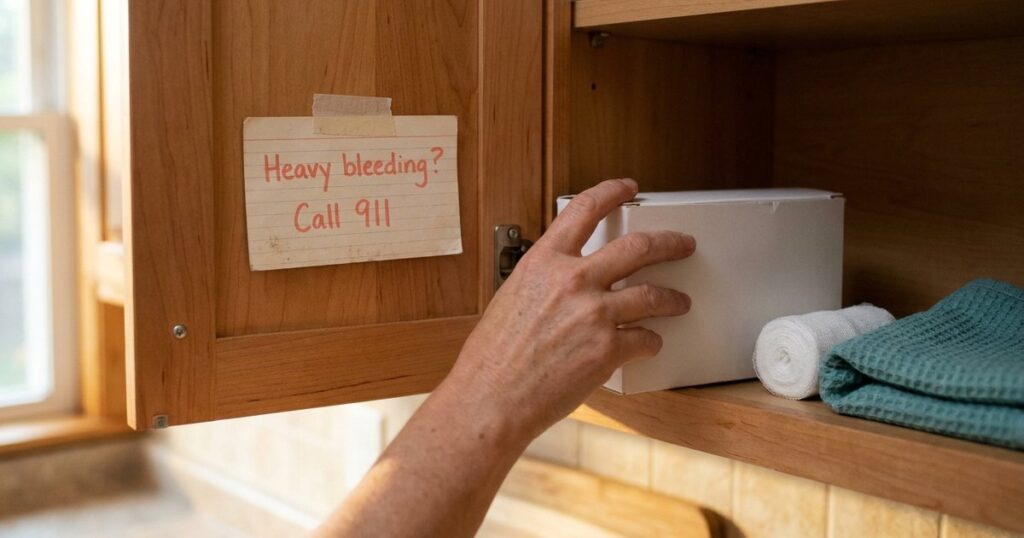
Most people typing “do I need stitches urgent care or ER” into a phone have the same two things going on: a cut that won’t quit and a clock running. Here’s the short answer. A cut that gapes but has slowed after firm pressure is usually fine at urgent care. Bleeding that won’t slow, a wound on the face, or an object still stuck in it belongs in the ER, and spurting blood means 911. For the bigger clinic-versus-hospital question, see our guide to choosing between urgent care and the ER.
Do I need stitches urgent care or ER: a 60-second sort
Press clean cloth on the cut. Then work through this.
- Spurting blood, or bleeding that soaks through the cloth and keeps going: call 911.
- Still bleeding after 10 to 15 minutes of steady pressure: get to urgent care or the ER now. Cleveland Clinic gives that 10-to-15-minute mark, and says to call 911 for spurting.
- Deep enough to see yellow fat, or the edges gape open when you let go: it almost certainly needs closing. Urgent care if it’s on an arm, leg or torso and has slowed; the ER if not.
- Face, a joint, or the groin area: lean toward the ER.
- Shallow, edges meet, bleeding has stopped: wash it and watch it at home.
Not sure? Pick the higher level of care.
How to know if a cut needs stitches
Cleveland Clinic’s emergency physicians describe a few signs that a wound needs closing, and they’re easy to check at the kitchen sink. If the cut is deep enough to show the middle layer of skin or the yellow fatty tissue under it, it needs medical attention and likely stitches. If it’s gaping, meaning you need more than gentle pressure to hold the edges together, it needs stitches or staples. If it’s on a joint, it will probably need them, and someone should check that the tendon and nerve are fine (Cleveland Clinic).
Say a knife slips across your palm on a Sunday. You press a towel on it for ten minutes. When you lift it, the bleeding has slowed to an ooze but the cut falls open as soon as you open your hand. That’s a stitches cut, and because the bleeding is under control, urgent care is a reasonable stop. Now say the same slip happens while you’re on blood thinners and the towel is soaked at the ten-minute mark. That’s a different situation, and the ER is the safer call.
Urgent care or ER for stitches: who should go where
Urgent care suits a controlled cut that needs closing, with X-ray on site if bone might be involved. Our page on urgent care in Youngstown and Boardman lists the clinics nearby. Go to the ER instead when the wound is any of these, drawn from Cleveland Clinic’s list and MedlinePlus:
- On the face. Scarring matters more there, and a plastic surgeon may need to see it.
- A bite that broke the skin. Animal or human, it needs care right away, and often antibiotics.
- Something is stuck in it. Don’t pull it out. It may be plugging a blood vessel.
- A crush injury or a hard, fast impact that left an open wound.
- The abdomen, pelvis, groin, neck or chest. MedlinePlus warns these can look minor and still bleed badly inside (MedlinePlus).
- A very dirty wound. Staff will need to clean it out first.
One local note. Since Northside Regional Medical Center closed in September 2018, the north side hasn’t had an emergency room of its own (see our list of Ohio hospital closures since 2018), so an ER trip from there means a drive. That’s one more reason to call 911 for severe bleeding instead of driving yourself. If you’re a parent, our guide to urgent care for kids in Youngstown covers which clinics see children.
Before you leave the house
A few things make the visit go better, and a couple of them are things not to do.
- Press firmly with a clean cloth, and raise the cut above heart level if you can. Keep pressing on the drive. If blood soaks through, add more cloth on top rather than lifting the first layer.
- Rinse with tap water and a little diluted liquid soap if the wound is dirty. Skip hydrogen peroxide. Cleveland Clinic says it doesn’t clean wounds well and can damage tissue.
- Tell staff if you take a blood thinner. MedlinePlus notes that people on them can bleed heavily from minor injuries, and the treatment plan can change.
- Don’t drive yourself if the injury makes driving hard, you feel faint, or you’ve lost more than a coffee cup’s worth of blood. Cleveland Clinic’s advice is to call someone or call 911.
Scalp cuts are the classic scare. MedlinePlus points out that a scalp wound can bleed a lot even when the injury is small. Firm pressure still works. A hard blow to the head, though, is an ER visit whatever the cut looks like.
How long after a cut can you still get stitches?
Cleveland Clinic says the window is about 24 hours. Past that you can technically still get them, but they won’t work as well. Waiting also raises infection risk and scarring. So if a cut gapes at 9 p.m., don’t wait to see how it looks in the morning. If it’s past a day already, go anyway. A provider can decide what’s best.
Tetanus: the question that comes with every cut
You’ll almost certainly be asked when your last tetanus shot was. MedlinePlus says boosters (Td or Tdap) are recommended every 10 years starting at age 19, and that injured adults, particularly with puncture-type wounds, should get one if more than 10 years have passed (MedlinePlus on tetanus). One myth to drop: the risk comes from dirt on a nail, not the rust. If you were hurt outdoors, or soil got in the wound, call your provider about your risk. Puncture wounds often don’t bleed much, so people skip care, but the infection risk is higher.
Can’t remember your last shot? Say so at check-in. Your own doctor’s office can look it up, and our guide on urgent care vs primary care vs telehealth explains when a call to the office beats a walk-in.
Urgent care or ER for a broken bone
MedlinePlus says to call 911 if the person is unresponsive, if there’s a suspected break in the head, neck or back, or in the hip, pelvis or upper leg, if you can’t fully immobilize the injury yourself, if bleeding is severe, if the area below the injury is pale, cold, clammy or blue, or if bone is poking through the skin (MedlinePlus on fractures). Don’t try to straighten it. Cover any open wound with a clean dressing.
Other breaks aren’t emergencies but still need prompt care. A swollen wrist after a fall, with normal color and feeling in the fingers, is a fair urgent care visit if the clinic has X-ray. For a child who refuses to use an arm or leg after a fall, MedlinePlus says to assume a break and get help.
Cost and coverage
Urgent care is usually the cheaper stop for a cut that doesn’t need a hospital. If you’re uninsured, our guide to urgent care cost without insurance in Ohio explains what to ask before you’re treated. Cost is a fine tiebreaker, but not a reason to pick a clinic for bleeding you can’t control.
FAQ
Does urgent care do stitches?
Usually, yes. Most walk-in clinics close simple cuts with stitches, skin glue or staples. A cut on the face, a cut over a joint, a deep wound or anything with bleeding you can’t slow is better handled in an emergency room. Call ahead if you’re unsure, and call 911 for bleeding that spurts.
How long can you wait to get stitches?
Cleveland Clinic puts the window at about 24 hours. After that, stitches can still be placed, but they tend not to work as well. Don’t use that as a reason to sit on a deep cut overnight. Infection risk and scarring both go up the longer a wound stays open.
Should I go to urgent care or the ER for a broken bone?
A suspected break with no skin broken, normal color below the injury and an injury you can fully support can go to urgent care with X-ray. Call 911 for bone through the skin, a pale, cold or blue limb below the injury, a suspected break in the head, neck, back, hip, pelvis or upper leg, or severe bleeding.
Do I need a tetanus shot after a cut?
Maybe. MedlinePlus says adults should have a Td or Tdap booster every 10 years, and that injured adults, especially with puncture wounds, should get one if it has been more than 10 years. If you can’t remember your last shot, tell the clinic when you check in.
Sources
- Cleveland Clinic: Here’s how to tell if your cut needs stitches
- MedlinePlus: Bleeding
- MedlinePlus: Broken bones (fractures), first aid
- MedlinePlus: Tetanus
How we put this guide together: we researched it from the official and medical sources listed above and reviewed it on November 4, 2026. Northside Youngstown Health Guide is independent. We aren’t affiliated with any hospital, insurer or government agency. This guide is general information, not medical advice. For an emergency, call 911, and talk to a clinician about your own injury.
Last reviewed: November 4, 2026